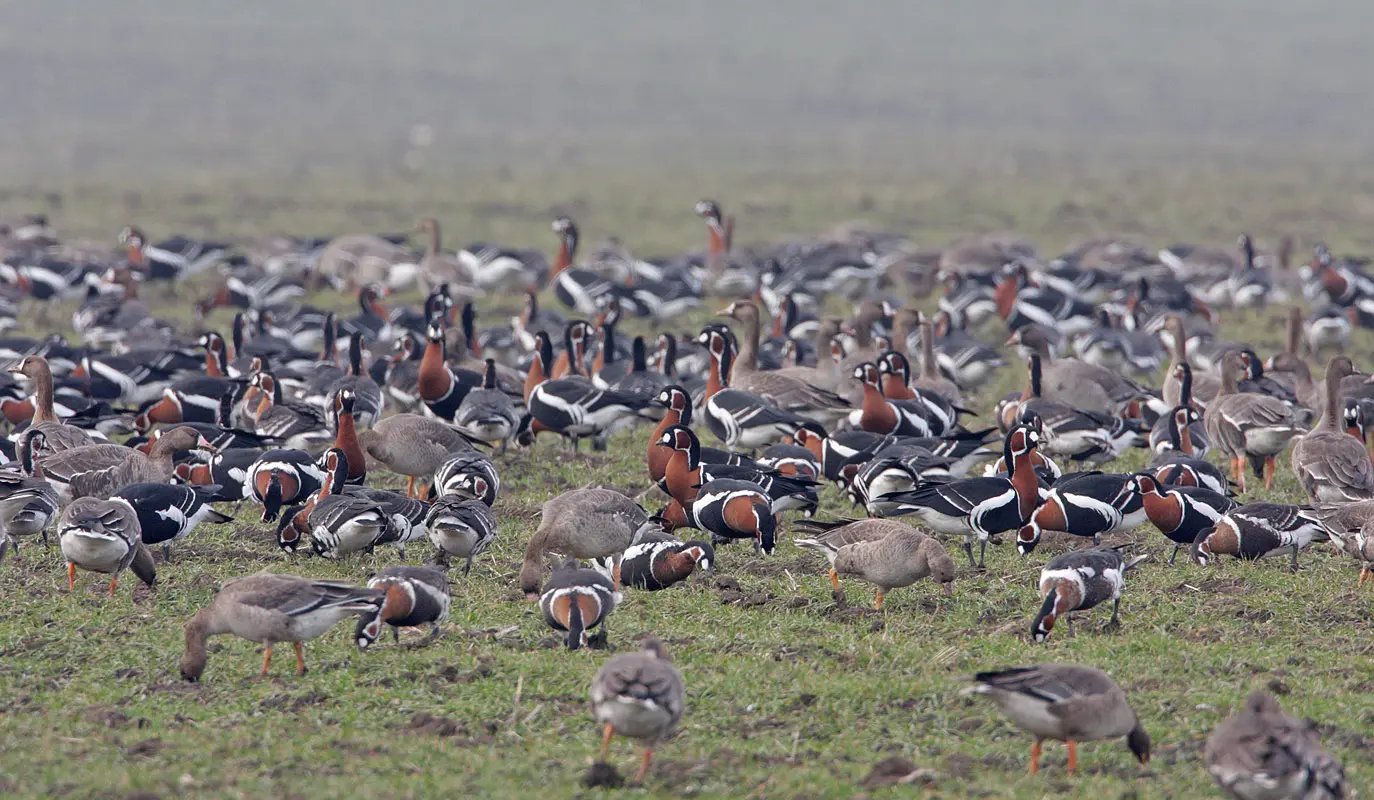
The Red-breasted Geese are well-known for their incredible beauty! These small natural pieces of art are also known for being endangered as species and for being the the smallest representative of the Geese family. They have wing span of about 110-125 cm and weight of 1-1,5 kg.
According to the latest scientific data the population of the Red-breasted Geese is not more than 50-60 specimen. This bird is under the legal protection of many national and international regulations and is listed in the IUCN Red list in the category Endangered. Still, it happens to become victim of poaching and its survival during the winter and long migrations is strongly depending on the tolerance of people.
Bulgaria bears the great responsibility for the survival of this species as more than 80% of the world population of the Red-breasted Geese spends the winter on its territory, especially in the colder winters.
The reason for the creation of this website is to popularise the necessity of taking greater responsibility towards the endangered species, incl. the Red-breasted Geese on the territory of Bulgaria.
It depends on the everyday choices of every one of us, if these beautiful creatures will survive!
Breeding
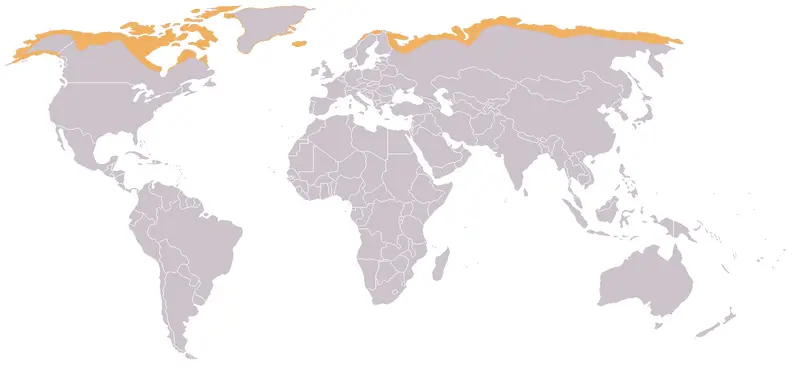
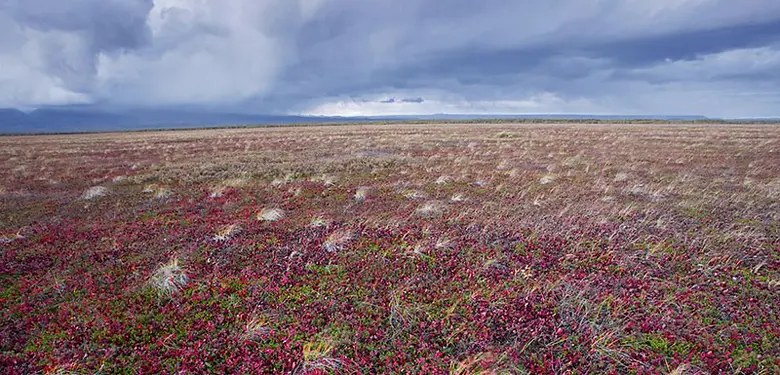
The Red-breasted Geese nest in the most northern parts of Russia – the tundra of the peninsulas of Taymir, Yamal and Gidan. These are some of the most beautiful and most severe places on Earth.
Breeding
The geese lay their eggs on the ground. Their strategy for protection against predators is to make their nests near the nests of Snowy owls (Bubo scandiacus) and Peregrine Falcons (Falco peregrinus). While guarding their own nests the raptor birds involuntarily guard the nests of the Red-breasted Geese, too.
(ph. Мichael Мelford)
The geese form small colonies of 4-5 nests and every female lays 4-6 eggs. The chicks hatch robust enough to walk and feed by themselves. The pairs are monogamous and every year have only one brood. The nesting period starts in June and the autumn migration starts in September. For this short period the young geese have to grow strong enough to be able to make the great flight to the Balkan Penisnsula!
Migration
The Red-breasted Geese fly about 8000 kilometers untli they reach their wintering habitats in Bulgaria and Romania. The places for rest of the geese along their long route are not well studied yet, but researches are currently being implemented. It is known that that the geese need water reservoirs in which they can pass the night peacefully. Along their route the geese also need appropriate pastures to feed and, which is most important, tolerant attitude from the local people. In most of the countries the hunt of Red-breasted Geese is forbidden. What can still be improved is the control of poaching and the level of public awareness.
The most of the Red-breasted Geese fly along the Ob River and reach the coast of the Caspian Sea. From this point of the migration route about 80% of the world population of the species head west towards the Balkan Peninsula. Very few geese sometimes fly over the Ural Mountains and most probably such specimen have been observed in Hungary and Serbia. Some birds chose to stay at the coast of the Caspian Sea and others head for the Aral Sea. These groups, though, are very small in number.
Migration
Until the 50s of the previous century most of the Red-breasted geese were spending the winter in Azerbaidzhan. They changed their wintering areas and have chosen the region of Dobrudzha in Romania and Bulgaria (close to the Black Sea coast). The reason was that the traditional farming(which provided appropriate pastures for the geese) at the Caspian Sea coast was changed with cotton plantations.
Wintering
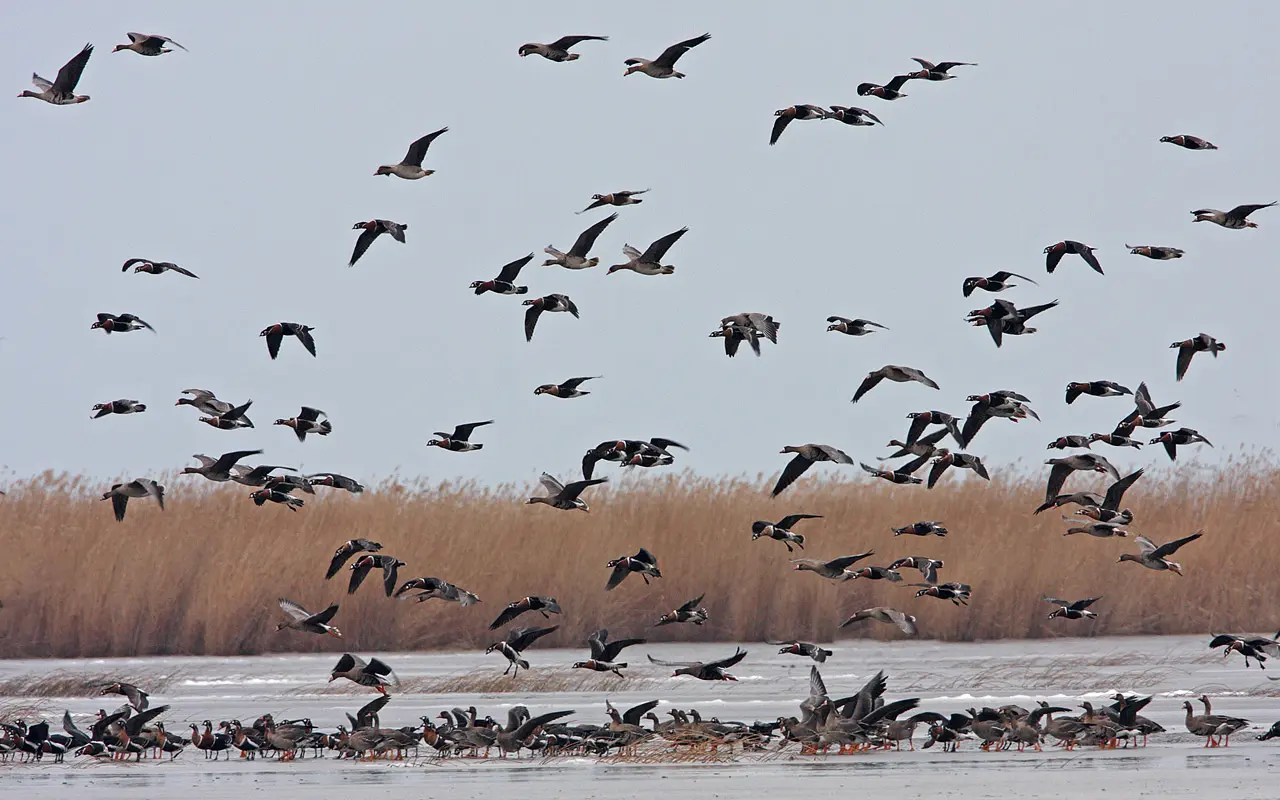
Most of the Red-breasted geese spend the winter in coastal Dobrudzha – Northeast Bulgaria and Southeast Romania, as the biggest numbers of geese are usually counted at the Lakes Shabla and Durankulak in Bulgaria. Both lakes are in the Ramsar Convention List of Wetlands of International Importance. Except for giving shelter to the Red-breasted Geese, these wetlands are important for many other species.
photo Emil Enchev
The geese spend the night in the lakes and early in the morning fly towards the adjoining fields sown with grain crops. The Red-breasted Geese feed in mixed flocks with the Greater White-fronted Geese and the Greylag Geese, and often close to them also pasture smaller flocks of swans.
photo Emil Enchev
A peaceful wetland for the night rest and lavish food are the two vital factors, which attracted the geese to the region of Shabla and Durankulak.
In warmer winters the geese move north to Romania and Ukraine and in very cold months Red-breasted geese can be seen at the Burgas Lakes and at the big dams in South Bulgaria.
Cookies help us improve our services. By browsing the content of the site, you also agree to the use of cookies.