Data from satellite tracking of rare and endangered bird species such as the Eastern imperial eagle, black vulture, saker falcon, lesser kestrel, griffon vulture, geese, ducks, cormorants, and others show alarming trends resulting from military actions, according to Green Balkans.
Through satellite transmitters equipped with more than 50 individuals from the listed protected species, conservationists from Green Balkans, FWFF, and the Sinite Kamani Nature Park Directorate are increasingly recording deterioration or complete loss of signal from the devices used to tag the birds. As a result, significant gaps or inaccuracies are appearing in the data on the routes and migration of the studied species, making it difficult to accurately analyze their behavior and threats.
The likely cause of this is the active interference with GPS systems by the warring parties, which can affect GPS signals over distances of hundreds of kilometers. Similar activities have also been reported in civil aviation. A widely reported incident involved a flight carrying the President of the European Commission, Ursula von der Leyen, during her visit to Bulgaria. At that time, the GPS signal disappeared during the aircraft’s approach to landing at Plovdiv Airport. Similar cases have also been reported in the Baltic states and Finland.
The data from a study of satellite transmitters used to track rare and protected bird species show that the negative impact on the signal falls into two main types. GNSS jamming refers to signal interference in which the receiver cannot reliably connect to or track satellite signals, and positioning becomes degraded or is completely lost.
The other, more frequently recorded type of interference identified by Green Balkans is GNSS spoofing—signal substitution or falsification. In these cases, the receiver does not simply lose signal, but may report an incorrect position, as if it were located in a completely different place. Some specialized international organizations, such as the European Union Aviation Safety Agency (EASA), define this as the transmission of false information to the receiver, while the International Civil Aviation Organization (ICAO) describes it as GNSS-like signals being captured instead of the real ones.
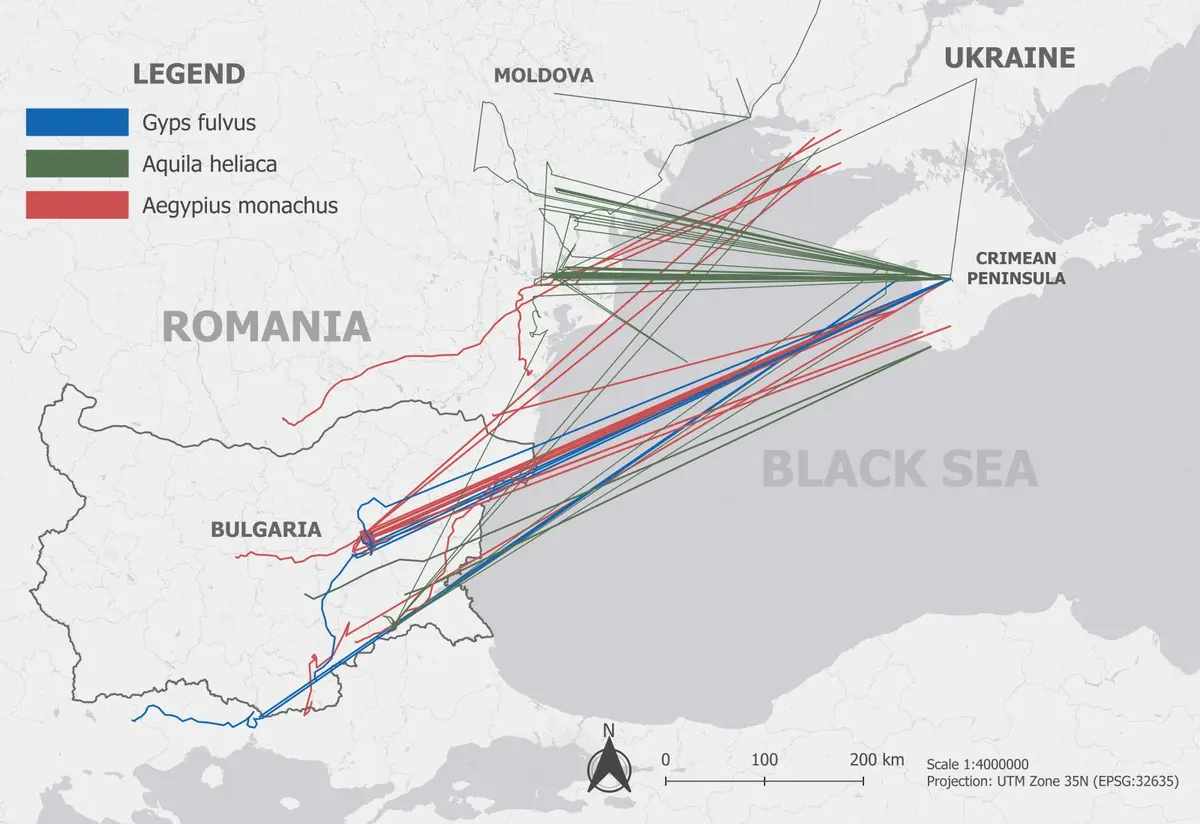
During bird tracking, the conservation team has observed how individual birds that are at a given moment within the borders of Bulgaria suddenly “move” hundreds of kilometers away, with their positions appearing in the territory of other countries. As shown on the attached map, such “false” positions very often appear in the area of the Crimean Peninsula and the northwestern Black Sea coast.
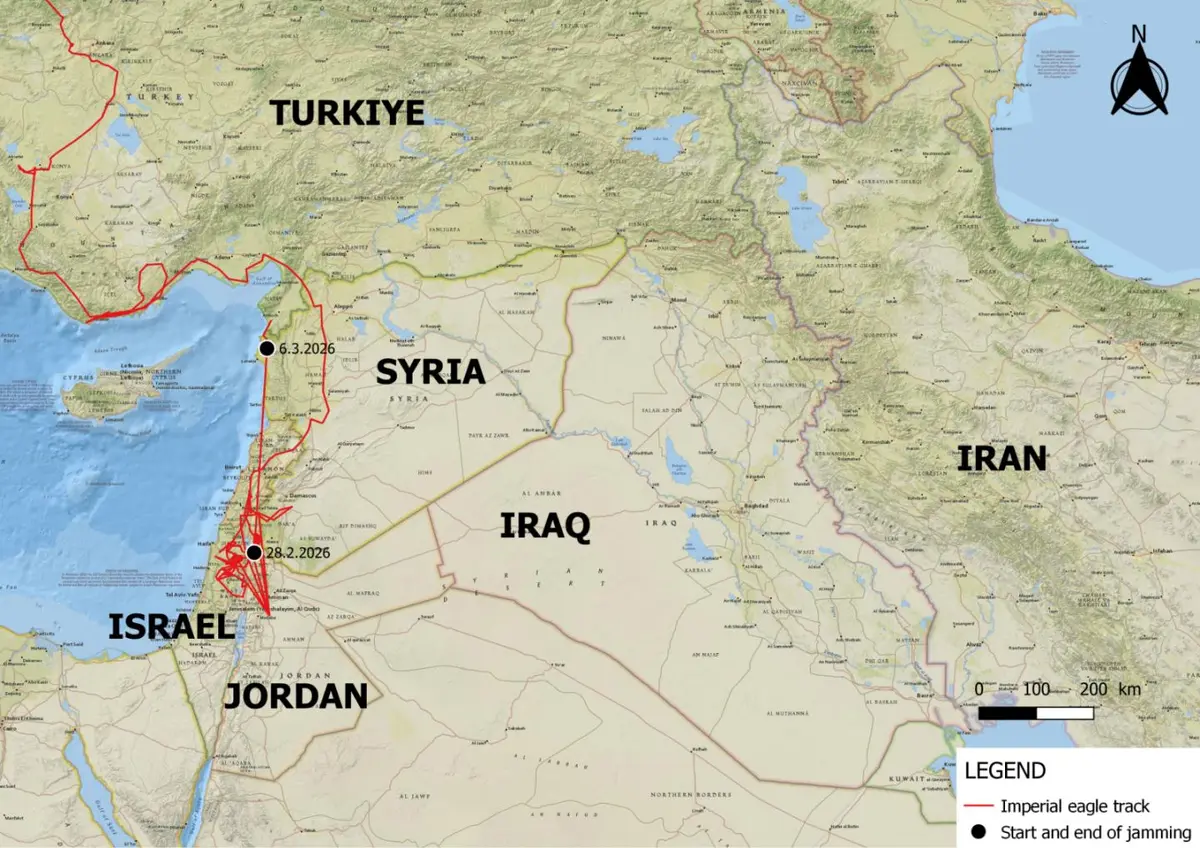
This type of interference was first identified by the team as early as 2024, when an Eastern imperial eagle tagged in Bulgaria transmitted a signal from the area of military operations in Ukraine. Signal jamming has also been recorded in another individual—again an Eastern imperial eagle (map 2), which was wintering in Israel during the winter of 2025/2026. After the outbreak of military actions in the Middle East, the signal from the device used to track the bird was lost for several days. Only after the bird headed north and left the perimeter of the conflict did the signal resume and the transmission of accurate positions was restored.
To enable a more in-depth analysis of these issues, scientists from Nikola Vaptsarov Naval Academy and the Agricultural University – Plovdiv have been engaged alongside the conservation teams. The maps and analyses were produced with the participation of our colleagues Dimitar Popov and Hristo Peshev, as well as the volunteers Ivaylo Chukarov and Cornel Cotorogea.
The tracking of birds using satellite transmitters is carried out within several projects implemented by Green Balkans under the EU LIFE Programme, either independently or in partnership with the FWFF and the Sinite Kamani Nature Park Directorate. These include ‘Life for the Lesser Kestrel’ (LIFE19 NAT/BG/001017), ‘Life for the Bearded Vulture’ (project No. 101113869 LIFE22-NAT-BG-Bearded Vulture LIFE), ‘Bright Future for the Black Vulture’ (LIFE14 NAT/BG/649), as well as ‘Conservation of Flagship Bird Species and Capacity Building in the Balkan Green Belt of Bulgaria and Turkey’ – BirdsBELT (BN_23_26), implemented with the financial support of the European Union’s BESTbelt project, in partnership with the Turkish organization ‘Back to Nature’ and the German foundation EuroNatur.
Last but not least is the project ‘Long-term Programme for the Conservation of the Red-breasted Goose’, supported by the EECONET Action Fund (Netherlands), the EuroNatur Foundation (Germany), the Frankfurt Zoological Society, and the Committee Against Bird Slaughter (Germany), as well as the programme for the recovery of the saker falcon in Bulgaria, which is implemented with the support of the Mohamed Bin Zayed Raptor Conservation Fund.
For more information:
Gradimir Gradev – Project Manager, ‘Life for the Lesser Kestrel’ (LIFE19 NAT/BG/001017)
Phone: +359 885 609 289
Email: ggradev@greenbalkans.org
Through satellite transmitters equipped with more than 50 individuals from the listed protected species, conservationists from Green Balkans, FWFF, and the Sinite Kamani Nature Park Directorate are increasingly recording deterioration or complete loss of signal from the devices used to tag the birds. As a result, significant gaps or inaccuracies are appearing in the data on the routes and migration of the studied species, making it difficult to accurately analyze their behavior and threats.
The likely cause of this is the active interference with GPS systems by the warring parties, which can affect GPS signals over distances of hundreds of kilometers. Similar activities have also been reported in civil aviation. A widely reported incident involved a flight carrying the President of the European Commission, Ursula von der Leyen, during her visit to Bulgaria. At that time, the GPS signal disappeared during the aircraft’s approach to landing at Plovdiv Airport. Similar cases have also been reported in the Baltic states and Finland.
The data from a study of satellite transmitters used to track rare and protected bird species show that the negative impact on the signal falls into two main types. GNSS jamming refers to signal interference in which the receiver cannot reliably connect to or track satellite signals, and positioning becomes degraded or is completely lost.
The other, more frequently recorded type of interference identified by Green Balkans is GNSS spoofing—signal substitution or falsification. In these cases, the receiver does not simply lose signal, but may report an incorrect position, as if it were located in a completely different place. Some specialized international organizations, such as the European Union Aviation Safety Agency (EASA), define this as the transmission of false information to the receiver, while the International Civil Aviation Organization (ICAO) describes it as GNSS-like signals being captured instead of the real ones.
During bird tracking, the conservation team has observed how individual birds that are at a given moment within the borders of Bulgaria suddenly “move” hundreds of kilometers away, with their positions appearing in the territory of other countries. As shown on the attached map, such “false” positions very often appear in the area of the Crimean Peninsula and the northwestern Black Sea coast.
This type of interference was first identified by the team as early as 2024, when an Eastern imperial eagle tagged in Bulgaria transmitted a signal from the area of military operations in Ukraine. Signal jamming has also been recorded in another individual—again an Eastern imperial eagle (map 2), which was wintering in Israel during the winter of 2025/2026. After the outbreak of military actions in the Middle East, the signal from the device used to track the bird was lost for several days. Only after the bird headed north and left the perimeter of the conflict did the signal resume and the transmission of accurate positions was restored.
To enable a more in-depth analysis of these issues, scientists from Nikola Vaptsarov Naval Academy and the Agricultural University – Plovdiv have been engaged alongside the conservation teams. The maps and analyses were produced with the participation of our colleagues Dimitar Popov and Hristo Peshev, as well as the volunteers Ivaylo Chukarov and Cornel Cotorogea.
The tracking of birds using satellite transmitters is carried out within several projects implemented by Green Balkans under the EU LIFE Programme, either independently or in partnership with the FWFF and the Sinite Kamani Nature Park Directorate. These include ‘Life for the Lesser Kestrel’ (LIFE19 NAT/BG/001017), ‘Life for the Bearded Vulture’ (project No. 101113869 LIFE22-NAT-BG-Bearded Vulture LIFE), ‘Bright Future for the Black Vulture’ (LIFE14 NAT/BG/649), as well as ‘Conservation of Flagship Bird Species and Capacity Building in the Balkan Green Belt of Bulgaria and Turkey’ – BirdsBELT (BN_23_26), implemented with the financial support of the European Union’s BESTbelt project, in partnership with the Turkish organization ‘Back to Nature’ and the German foundation EuroNatur.
Last but not least is the project ‘Long-term Programme for the Conservation of the Red-breasted Goose’, supported by the EECONET Action Fund (Netherlands), the EuroNatur Foundation (Germany), the Frankfurt Zoological Society, and the Committee Against Bird Slaughter (Germany), as well as the programme for the recovery of the saker falcon in Bulgaria, which is implemented with the support of the Mohamed Bin Zayed Raptor Conservation Fund.
For more information:
Gradimir Gradev – Project Manager, ‘Life for the Lesser Kestrel’ (LIFE19 NAT/BG/001017)
Phone: +359 885 609 289
Email: ggradev@greenbalkans.org