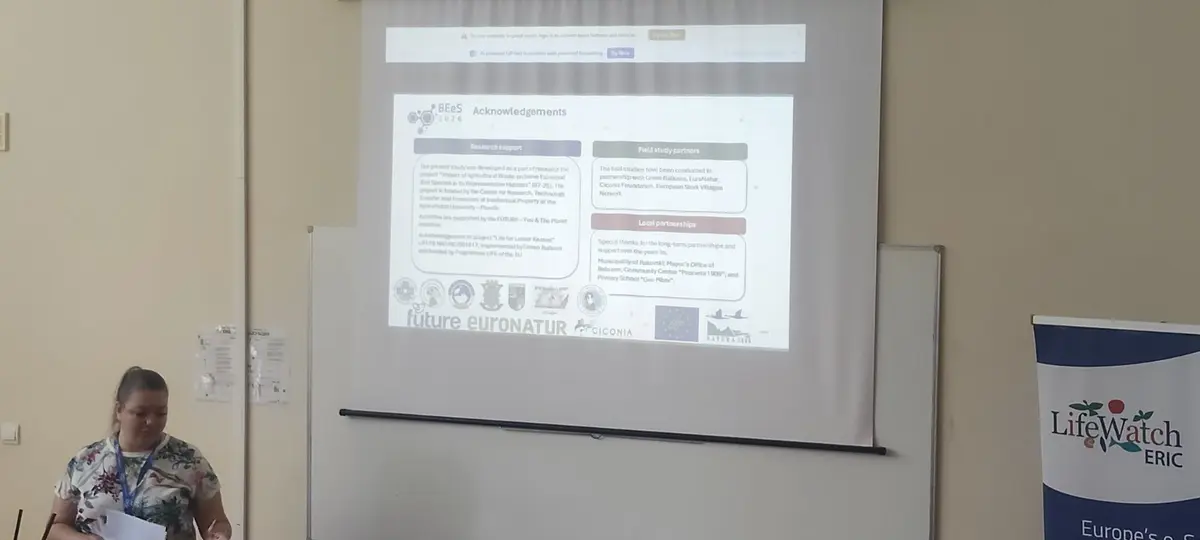
From 7 to 10 July 2026, the city of Plovdiv hosted the LifeWatch ERIC Biodiversity & Ecosystem eScience Conference (BEeS2026), one of the leading international scientific events dedicated to biodiversity, ecosystems, and cutting-edge technologies for their research and conservation. The conference was hosted by the Agricultural University of Plovdiv, bringing together scientists, researchers, conservationists, and environmental experts from across Europe and beyond to exchange knowledge and promote innovative approaches to biodiversity conservation.
The conference featured 12 scientific thematic sessions, covering some of the most pressing topics in ecology and conservation, including biodiversity conservation and ecosystem health, metagenomics and environmental DNA (eDNA), animal behaviour and biotracking, biodiversity monitoring and data services, the impacts of climate change on ecosystems, restoration of marine and freshwater environments, soil biodiversity and microbiology, ecological modelling, agroecology, and many other emerging fields.
Among the active contributors was the Green Balkans team, which presented its scientific and practical conservation experience in four thematic sessions. The organisation shared the results of long-term research and conservation activities through the following presentations:
Gradimir Gradev – Negative Impact by Military Electronic Technologies on Satellite Telemetry of Birds. Understanding the impact of military electronic technologies on satellite telemetry is crucial for ensuring reliable bird tracking and the effective conservation of wild bird populations.
Stilyana Yaneva – Population Dynamics of the White Stork in Belozem – the European Stork Village in Bulgaria, During the Period 2015–2025, a topic whose importance is further underscored by the financial support of the FUTURE – You & The Planet programme.
Dimitar Popov – Satellite Telemetry of European Shags along the Bulgarian Black Sea Coast. The activities are part of Green Balkans' conservation efforts to protect the endangered Red-breasted Goose.
Elena Tilova – Energy-Efficiency Measures Threaten Important Habitats of Protected Species in Buildings: Evidence from a National Monitoring Study in Bulgaria.
A special focus of Green Balkans' participation was the extensive experience gained through the application of modern wildlife monitoring techniques, particularly satellite telemetry, within the framework of the "Life for the Lesser Kestrel" project (LIFE19 NAT/BG/001017).
The project is the first—and to date the only—initiative in Bulgaria dedicated to restoring the Lesser Kestrel as a breeding species following its extinction from the country during the 20th century. By combining innovative scientific methods, international cooperation, and advanced monitoring technologies, the project team collects valuable data on the movements, behaviour, and survival of the birds. This information supports the development of effective conservation measures and contributes to the long-term recovery of the species. The results presented at BEeS2026 clearly demonstrate how scientific research can be successfully translated into practical conservation solutions.
Green Balkans' participation in this international forum further reinforces the organisation's role as one of Bulgaria's leading conservation NGOs and a valued partner within the European scientific community. The conference provided an excellent platform for exchanging knowledge, establishing new collaborations, and showcasing successful Bulgarian conservation practices to an international audience—another important step towards the effective protection of Europe's natural heritage.
The conference featured 12 scientific thematic sessions, covering some of the most pressing topics in ecology and conservation, including biodiversity conservation and ecosystem health, metagenomics and environmental DNA (eDNA), animal behaviour and biotracking, biodiversity monitoring and data services, the impacts of climate change on ecosystems, restoration of marine and freshwater environments, soil biodiversity and microbiology, ecological modelling, agroecology, and many other emerging fields.
Among the active contributors was the Green Balkans team, which presented its scientific and practical conservation experience in four thematic sessions. The organisation shared the results of long-term research and conservation activities through the following presentations:
Gradimir Gradev – Negative Impact by Military Electronic Technologies on Satellite Telemetry of Birds. Understanding the impact of military electronic technologies on satellite telemetry is crucial for ensuring reliable bird tracking and the effective conservation of wild bird populations.
Stilyana Yaneva – Population Dynamics of the White Stork in Belozem – the European Stork Village in Bulgaria, During the Period 2015–2025, a topic whose importance is further underscored by the financial support of the FUTURE – You & The Planet programme.
Dimitar Popov – Satellite Telemetry of European Shags along the Bulgarian Black Sea Coast. The activities are part of Green Balkans' conservation efforts to protect the endangered Red-breasted Goose.
Elena Tilova – Energy-Efficiency Measures Threaten Important Habitats of Protected Species in Buildings: Evidence from a National Monitoring Study in Bulgaria.
A special focus of Green Balkans' participation was the extensive experience gained through the application of modern wildlife monitoring techniques, particularly satellite telemetry, within the framework of the "Life for the Lesser Kestrel" project (LIFE19 NAT/BG/001017).
The project is the first—and to date the only—initiative in Bulgaria dedicated to restoring the Lesser Kestrel as a breeding species following its extinction from the country during the 20th century. By combining innovative scientific methods, international cooperation, and advanced monitoring technologies, the project team collects valuable data on the movements, behaviour, and survival of the birds. This information supports the development of effective conservation measures and contributes to the long-term recovery of the species. The results presented at BEeS2026 clearly demonstrate how scientific research can be successfully translated into practical conservation solutions.
Green Balkans' participation in this international forum further reinforces the organisation's role as one of Bulgaria's leading conservation NGOs and a valued partner within the European scientific community. The conference provided an excellent platform for exchanging knowledge, establishing new collaborations, and showcasing successful Bulgarian conservation practices to an international audience—another important step towards the effective protection of Europe's natural heritage.

.JPG)