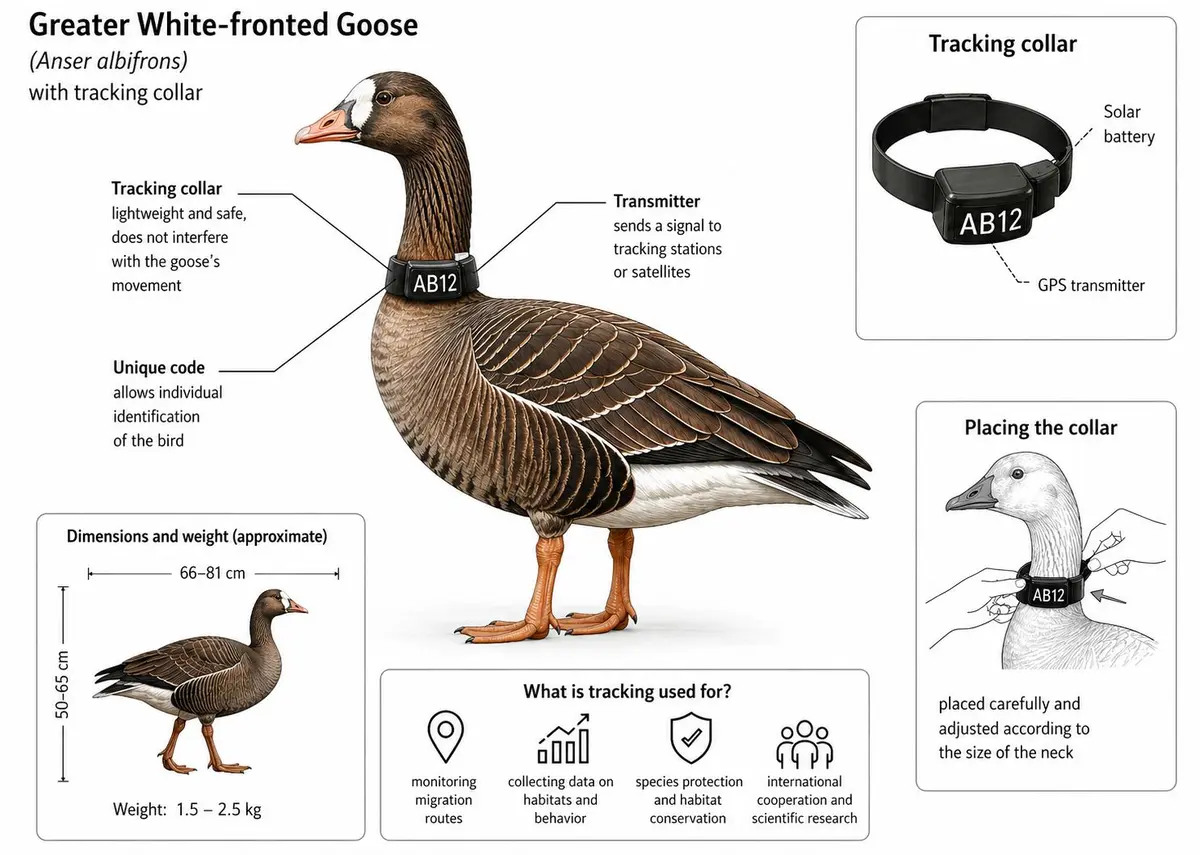
At the beginning of March, seven Greater White-fronted geese (Anser albifrons) were fitted with GPS transmitters in the area of Atanasovsko Lake (Burgas). Nearly a week later, the first two birds set off north and reached Romania, where they spent some time in Europe’s largest wetland – the Danube Delta. There, they feed and build up the energy they will need for the long flight north.
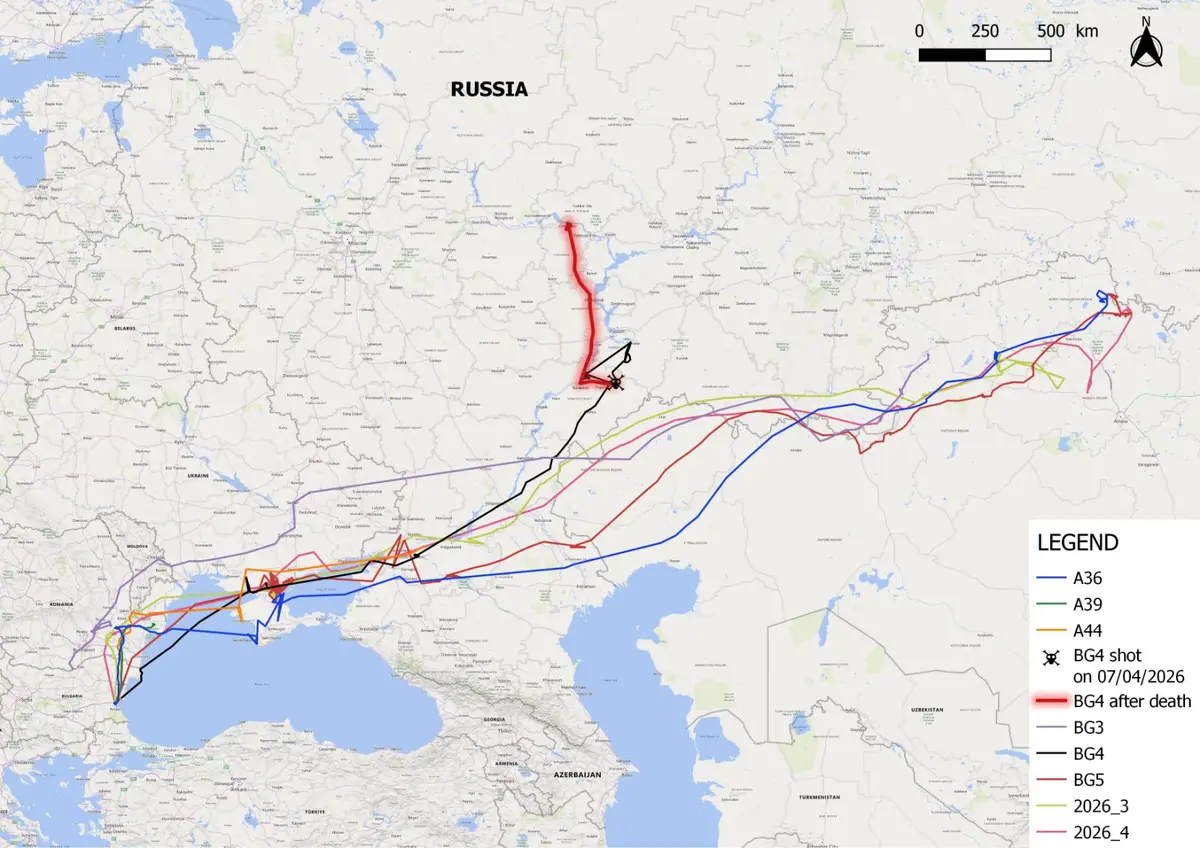
Over the past two months, the geese have gradually entered their long migration toward their breeding grounds beyond the Arctic Circle, in the tundra regions of Siberia. At present, four of the birds are already in Kazakhstan, and one goose tagged in 2025 is also there.
Unfortunately, not all stories have a happy ending. One of the geese was shot by a hunter in Russia, in the area of the Bolshoy Irgiz River. Its transmitter was later recovered in Chuvashia, where it continued to transmit throughout the entire time. Two other birds are currently not sending signals – one in the Danube Delta and the other in the Konstantinovsk area (Russia).
Some of the missing data is likely due to technical limitations and difficulties in transmitting signals from within Russia. This may be caused by limitations or instability in mobile networks there, as well as signal interference or jamming. As our team has previously noted, GPS signals from transmitters have been observed to be jammed or spoofed, a phenomenon that began with the start of the war in Ukraine.
We are eagerly awaiting new data from the final stage of this remarkable 8,000 km journey.
Over the past two months, the geese have gradually entered their long migration toward their breeding grounds beyond the Arctic Circle, in the tundra regions of Siberia. At present, four of the birds are already in Kazakhstan, and one goose tagged in 2025 is also there.
Unfortunately, not all stories have a happy ending. One of the geese was shot by a hunter in Russia, in the area of the Bolshoy Irgiz River. Its transmitter was later recovered in Chuvashia, where it continued to transmit throughout the entire time. Two other birds are currently not sending signals – one in the Danube Delta and the other in the Konstantinovsk area (Russia).
Some of the missing data is likely due to technical limitations and difficulties in transmitting signals from within Russia. This may be caused by limitations or instability in mobile networks there, as well as signal interference or jamming. As our team has previously noted, GPS signals from transmitters have been observed to be jammed or spoofed, a phenomenon that began with the start of the war in Ukraine.
We are eagerly awaiting new data from the final stage of this remarkable 8,000 km journey.
.JPG)